
c. 1837–1904
The creation of the Sanlúcar band
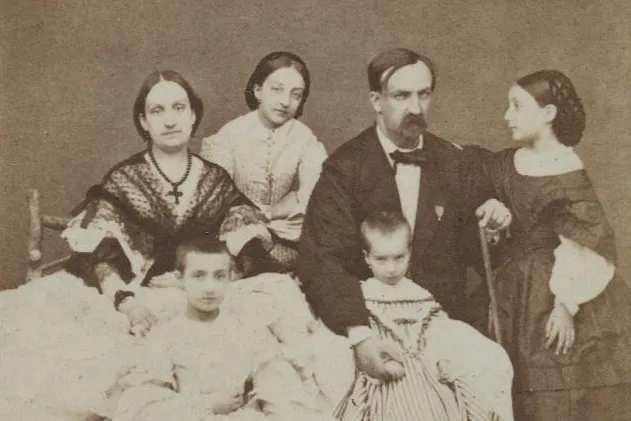
The concert band in Sanlúcar de Barrameda emerged within the context of social and cultural transformation that took place throughout the nineteenth century, when music began to detach itself gradually from the strictly religious sphere and enter civilian life. Until then, organised musical activity had been linked to the chapels of the main parish church of Our Lady of the O and the sanctuary of Our Lady of Charity, but the secularisation of society and the spread of musical education encouraged the emergence of musicians trained outside the ecclesiastical sphere and created the need for a band to attend the town's public events.
As early as 1837, documentary evidence confirms the existence of a "town music band" (as it was then called), present at civic, religious and political celebrations, organised and directed by Saturio Lindres de Arnedo - himself a musician from the chapel of the main parish church. Although in invoices Lindres sometimes referred to it as a "military music band", it was in practice a civilian band, in keeping with the conventions of the time. Lindres not only served as director but was also responsible for managing engagements and payments, maintaining a direct relationship with the Town Council.
The decision by the municipal authorities to formalise the band came after witnessing the consequences of its disorganisation in the mid-1840s. The absence of music at official events - especially at the receptions and farewells for the family of the Dukes of Montpensier, great music enthusiasts and key figures in the social life of Sanlúcar - prompted a reprimand from the civil governor. This led the council to agree, on 12 November 1852, to establish an official municipal band, institutionally recognising the ensemble already directed by Saturio Lindres and ensuring its presence at the town's main celebrations.
From then until the early twentieth century, the history of the Municipal Band of Sanlúcar was marked by a constant succession of directors, reorganisations and disbandments, reflecting a fragile structure and an unstable relationship with the Town Council. Among the principal musical directors of this long period were Saturio Lindres de Arnedo (1852-1857), Luis Ayllón de Soto (1864-1866) - under whom the Municipal Music Academy was formally established - Manuel Díaz (1866-1867), Eduardo Gutiérrez Henríquez (1868-1872), José Abollado Vaquerizo (1872-1875), Lucas Mayo Barriguete (1875-1880), Luis Fernández Saura (1880-1887), Francisco Peña Castro (from 1890, intermittently), as well as other directors who led parallel bands at various times.
Beyond individual names, this period was characterised by a precarious relationship between the band and the Town Council, based on informal agreements, payment per engagement and ongoing competition between public and private ensembles. Municipal music was subject to short-term economic considerations, with no stable planning or long-term artistic vision. This situation led, at the turn of the twentieth century, to a clearly deplorable state of affairs for the so-called Municipal Band, both organisationally and artistically, creating a climate of decline and uncertainty that explains the need for a profound renewal in the decades to come.
1904–1918
The first major period of stability
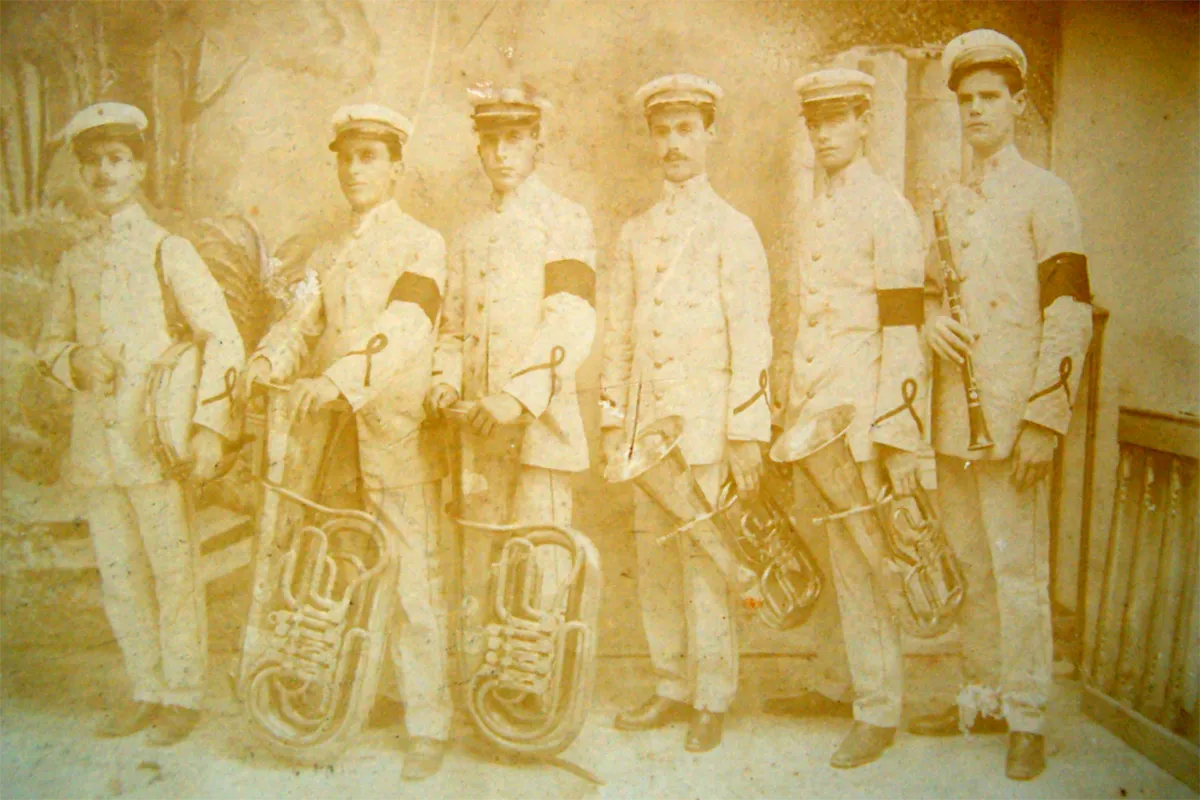
In 1904, faced with the band's decline, the Town Council of Sanlúcar created the post of municipal director as a permanent civil service position, thereby providing the stability needed to begin the first truly solid period for the Music Academy and Municipal Band of Sanlúcar.
This post was obtained by competitive examination by Mateo Alba Rodríguez (Zafra, Badajoz, 15 September 1867), who arrived in Sanlúcar at the end of 1904. He came with credentials as director of the municipal bands of Zafra and Badajoz, as a pianist, violinist and composer whose works had been premiered in theatres across Spain, and as a graduate of the Escuela Nacional de Música y Declamación - now the Royal Conservatory of Music of Madrid - where he had studied under Emilio Arrieta.
From the outset, Alba earned the respect and affection of the town. He provided musical education to numerous young people from Sanlúcar, assembled capable musicians to perform and, despite a shortage of instruments in good condition - which he resolved by pledging his wife's assets as collateral for their purchase - raised the repertoire to a higher standard, even securing engagements outside the town, such as at the Jerez fair.
He succeeded in having the Town Council approve the first Regulations for the Music Academy and Municipal Band of Sanlúcar (1912), which established daily wages for the musicians: a modest but historic framework that laid the foundations for the band's professionalisation.
Mateo Alba died prematurely on 26 May 1913, aged 45. His funeral was solemn and attended by large crowds: the Municipal Band accompanied his coffin with funeral marches to the cemetery, as a mark of the affection and respect the town held for him.
He was succeeded as director by Enrique Anadón González, a first-class military musician from Madrid who had been living in Sanlúcar for a couple of years. He resigned in 1917 after four years at the helm.
1918–1953
The second major period
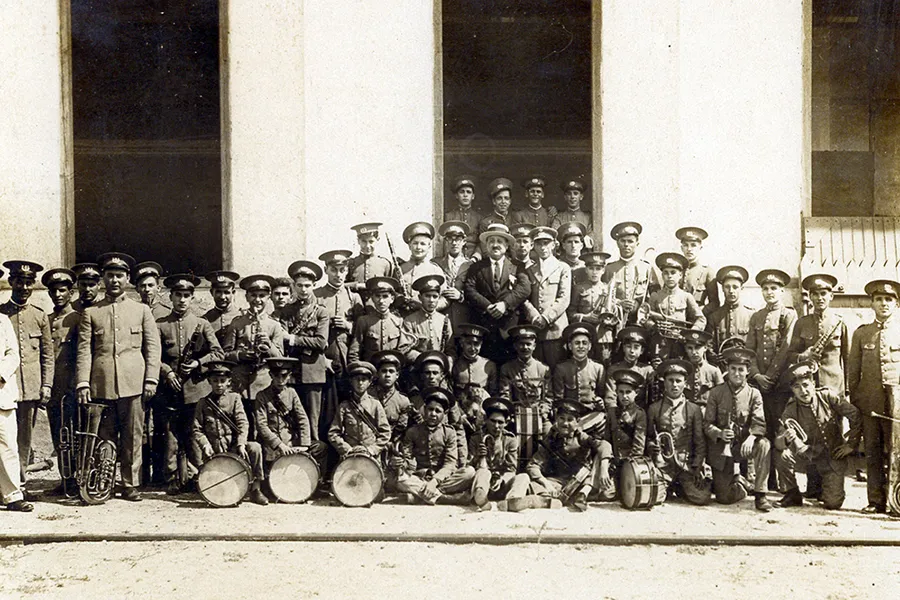
In 1918, Julián Cerdán Murillo (Acedo, Navarra, 1877) arrived - a retired military musician with an extensive and distinguished career - ushering in the second golden age of the Municipal Band, marked by employment and artistic stability.
Under his direction, the Regulations of 1924 and the Regulations of 1931 were approved, reflecting the band's progressive professionalisation: the former slightly improved the musicians' financial conditions, while the latter introduced a more robust system, with principal musicians receiving fair salaries and a clear hierarchical structure that consolidated the band as a stable institution.
This director not only developed the concert band but also created alongside it a bugles and drums ensemble that performed with the band at processions, concerts and street parades, as well as independently. The Sanlúcar band became a musical landmark in the town and across Andalusia, winning First Prize by unanimous decision at the Regional Competition for Municipal Bands (Écija, Seville, 1928) and taking part in the Holy Week processions of Jerez and Seville, where it accompanied the canopy of Our Lady of Succour in 1941.
Julián Cerdán was also a prolific composer, leaving dozens of popular scores, pasodobles and dances with which he won the hearts of Sanlúcar's audiences. A close friend of Joaquín Turina, he retired in 1952 after 34 years at the helm of the band, making him the longest-serving conductor in its history.
1953–1967
The third major period and the end of the Municipal Band
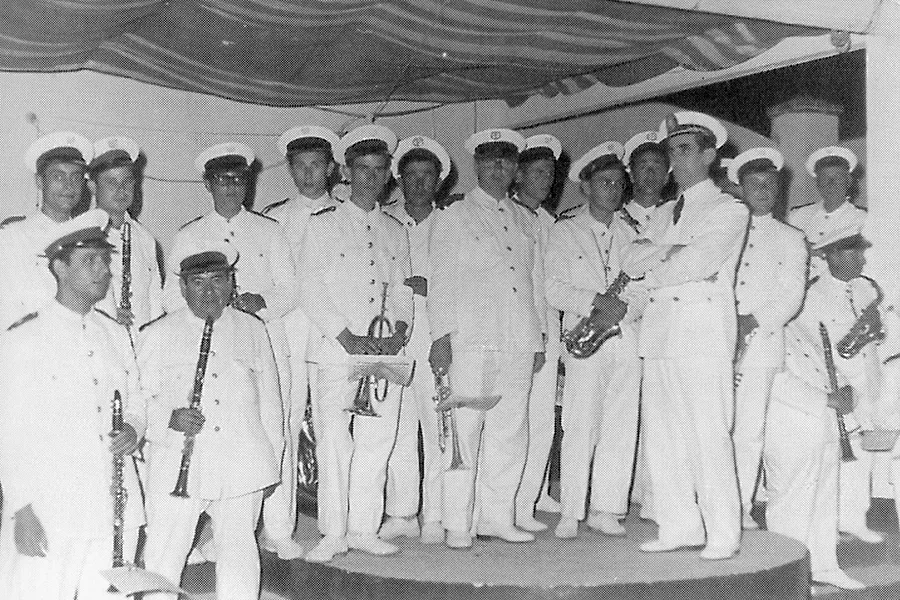
Following the retirement of Julián Cerdán in 1952, the post of municipal director was advertised once again. It was obtained by Marino Díaz Díaz (Cebreros, Ávila, 18 June 1901), a highly trained musician who had studied under Román de San José at the Academy of the Intendancy Corps (Ávila), under Luis Emilio Vega (director of the Alabarderos Band - now the Royal Guard Band) and under the celebrated Conrado del Campo at the Royal Conservatory of Music of Madrid. This background enabled him to develop a refined style as a musician and particularly as a composer, winning several national prizes.
Before coming to our town, he had successfully directed various municipal bands: Arévalo (Ávila), Baena (Córdoba) and Villanueva del Arzobispo (Jaén). In each of them he applied his own method: new regulations, renewal of instruments, training of musicians and enrichment of the repertoire.
Díaz arrived in Sanlúcar in April 1953, when the band had 23 musicians. From his very first day he gave classes, trained new students and drove forward a major reform. In 1955 he submitted a draft set of Regulations (finally approved in 1958) that significantly improved the musicians' financial and working conditions, establishing fair salaries by category and bonus payments. This reform professionalised the band, ensuring stability and consolidating its artistic standing.
In his first five years as director, Díaz had already trained some 140 students, of whom 60 had their own instrument and 14 had joined the band. The roster grew from 23 to 27 musicians, and over 200 works were premiered, including transcriptions and original compositions.
However, in 1963, new Spanish music legislation - ostensibly intended to improve musicians' conditions - was exploited by the Sanlúcar Town Council to roll back the 1958 Regulations, which had obliged it to maintain fixed salaries and a stable structure. In exchange for a promise of a one-off financial improvement, the system reverted to annually renewable agreements, restoring a precarious employment relationship that clearly benefited the council. Thus, when Marino Díaz retired in 1966 - his being the only truly municipal post that remained - the Town Council abolished the director's position in 1967, bringing to an end the Music Academy and Municipal Band of Sanlúcar as a stable institution.
1967–today
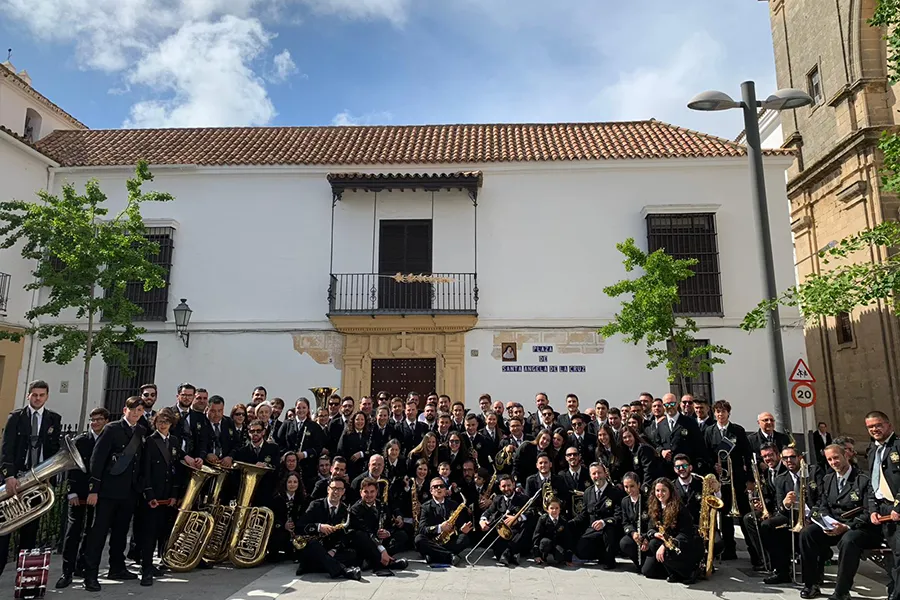
The current period
Following the effective disappearance of the Music Academy and Municipal Band in 1967, and with no regulations or stable link to the Town Council beyond the promise of annual agreements, the band was renamed the Saint Cecilia Concert Band. Two local musicians, Luis Romero Muñoz and Enrique Alfaro Amores, took turns as director with the aim of keeping both the band and the school alive, although ultimately both were dissolved in 1975.
After several failed attempts, the band was revived in 1980 through the creation of a private association, adopting the name Julián Cerdán in tribute to the maestro who had led it to its greatest heights. The first director in this new period was Rafael Rodríguez Márquez (1980–1984), a former musician and pupil of Julián Cerdán, and the principal advocate of the new name. He was followed by Salvador Daza Palacios (1984–1989), José Manuel Fernández Pérez (1989–1990), José Antonio López Camacho (1990–2010) and, from 2010 to the present day, Justo Manuel Jiménez Fábregas.
Now as a fully private institution, the Julián Cerdán Band has experienced a remarkable revival thanks to the sustained work of its music school, the commitment of its musicians and management that has enabled it to build a solid artistic and educational project. Hundreds of students have trained at its school, many of whom have gone on to join the band itself or have pursued formal music studies, directly contributing to the improvement of its performance standard.
A significant milestone of this period was the admission in 1987 of the first woman to the band, the Sanlúcar-born oboist Concha Gallego, reflecting an evolution in step with social and cultural change.
Throughout these years, the Julián Cerdán Band has been developing an intense concert activity, taking part in important festivals and performing on top level stages, both in Andalusia and abroad, while maintaining a close link with processional music. Since 1999, he has accompanied uninterruptedly the Brotherhood of Los Javieres without interruption, as well as collaborating with other brotherhoods and participating in notable Holy Week celebrations across various Andalusian towns, establishing itself as a widely recognised and sought-after band.
Its artistic standing has been further enhanced by commissions and dedications such as the works Magallanes (2002) and Sanlúcar de Barrameda (2005) by the composer Ferrer Ferrán, as well as by academic attention in specialist studies and publications. To this may be added various awards, including distinctions at regional competitions and the Prize for Cultural Excellence awarded by the Sanlúcar Town Council.
In 2010, as a logical step in this process of consolidation, a Foundation with the aim of preserving, protecting and projecting in the future the cultural legacy of the Julián Cerdán Band in Sanlúcar de Barrameda.
Today, the Julián Cerdán Band is one of the most solid and representative cultural references of its city, the result of a trajectory marked by improvement, continuity and social recognition.
 Español
  English (UK)